
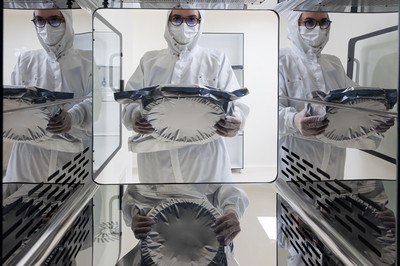
Eager to support robust expansion in the European chip market, the entrepreneurial couple intentionally relocated from Austria to Croatia to establish Meliori. Currently the only company to manufacture, clean, ship and refurbish polymeric semiconductor support frames in Europe, Meliori’s 350 square metre facility is based in Croatia’s Šibenik Industrial Zone.
In addition to the injection moulding cell, the facility houses a full-automated CNC machine to remove burrs from the eight-inch frames. There is also an automated washing and drying cell, a dedicated ISO Class 6 packaging cleanroom, as well as the space to scale up and add two more production lines as word of mouth about their sustainable semiconductor frames spreads across the continent.
Given the high demands for cleanability and repeatability, a Sumitomo (SHI) Demag IntElect injection moulding machine was installed to manufacture the wafer frames. The company’s German mould maker endorsed their machine choice asserting to Omazić that in their professional opinion the IntElect was the best in the business. The entire production cell, including all of the machine ancillaries, the Wemo Automation 6-axis pick and place robot, and cleaning cell was selected, supported and validated by local Slovenian distributor Top Teh d.o.o.
Spotting venture potential
Like many formative companies, despite the promising market opportunities Meliori struggled to generate interest from many of the big moulding machine suppliers. Company founder Marko Omazić recalls:“The biggest motivation for us was working with a local supplier who was genuinely interested in bringing our idea to life. Matjaž Kos from Top Teh invested the time and energy, presenting us with options for a complete production line, including the all-electric moulding machine from Sumitomo (SHI) Demag.”
Installing a standard IntElect machine offered more than enough features and production repeatability, affirms Matjaž Kos. “It is a simple case of a quality machine delivering everything that Meliori needs to exceed the manufacturing precision, reliability and price per unit of current chip frames being imported into Europe from Asia. The team especially valued having direct access to our local machine validation, process optimisation and training support.”
Marko and Antonia Omazić also drew upon their extensive material and photovoltaic knowledge to ensure that the raw material would deliver the mechanical properties and tensile strength required. The eight-inch wafer frame is moulded from a glass fibre and mineral filled polyphenylene sulphide compound. This enables Meliori to offer a unique refurbishment service.
“Rather than single use components that generates excess waste, we intentionally wanted to ensure that the frames were moulded from a robust material that could be returned to our facility, where they are quality checked, refurbished, cleaned, repacked and shipped back to customers.
“This service is central to our sustainability journey and aqua-friendly manufacturing and cleaning process. Combined with the energy and efficiency savings gained from using the Sumitomo (SHI) Demag IntElect machine, the CO2 and waste management savings are huge,” highlights Antonia Omazić.
Made in the EU for self sufficiency
As chip manufacturing can be resource intensive, the measures implemented by Meliori support the sustainability efforts of European semiconductor manufacturers, reports Antonia Omazić. “By integrating renewable energy sources, using innovative materials, and embracing a circular economy approach, the European semiconductor industry can significantly enhance its sustainability credentials,” adds the PhD polymer and semiconductor specialist.
Frame stability is especially important for the chip manufacturing process states Omazić. Without the stability of the semiconductor wafer, chips just simply would not exist. The process involves a polymer film being glued to a single polymer wafer support, onto which a disk with chips is then glued. There can be 1,000 to 10,000 of them, depending on the size and technology. The cutting process then requires meticulous stability, as the chips are mechanically hard, yet each thinner than a single hair strand.
By localising the value chain, the quality of wafer frames can be tightly controlled. It also addresses recent geopolitical risks and supply chain challenges “With the addition of AI and automation, European suppliers like us can now offer chip manufacturers in this fast-moving market a competitive alternative to buying semiconductor frames from Asia,” claims Antonia Omazić.
With Europe’s rallying cry to foster greater collaboration in the semiconductor market, the move by the two spouses and four Meliori engineers is a confident one. Yet it is equally closely aligned to the EU Chips Act and Chips Joint Undertaking (Chips JU) initiative which seeks to enhance digital capabilities and sustainability in the growing domestic semiconductor ecosystems, especially hotspots like Ireland, the UK and mainland Europe.
Sumitomo (SHI) Demag chief sales officer Anatol Sattel comments: “The semiconductor market in Europe is evolving rapidly. Growing demand for advanced electronics, for example smartphones, laptops, electric vehicles, as well as AI, industrial robots, and healthcare is leading to a surge in demand for local infrastructures, R&D semiconductor hubs and manufacturing support. Enterprises like Meliori supported by local machinery manufacturers and integrators will play a critical role in building self-sufficiency and mobilising these opportunities.”
By focusing exclusively on the European market, and with a large preorder for wafer frames confirmed by one of Europe`s largest manufacturer of semiconductors, the standards are set at the highest level, and the doors of opportunity are wide open for further contracts. “This intent to order was the strongest vote of confidence in our product. Our long-term plan is to continue innovating and using our market knowledge to expand and diversify our product portfolio, as well as open our own R&D centre. Elevating our Made in the EU status,” ends Antonia Omazić.